

In the AI field, we have long been accustomed to this perception: suffixes like "Flash", "Mini", and "Nano" mean a compromise in performance—they are cheaper and faster, but must bow to flagship models like "Pro" and "Ultra" in terms of capability.
However, Google's newly released Gemini 3 Flash is breaking this industry convention. According to the latest data from the independent evaluation platform Artificial Analysis, this lightweight model not only surpasses competitors of the same class in several key indicators but even "punches above its weight" to beat its own flagship model, Gemini 3 Pro, in certain areas.
But behind this impressive report card lies an alarming statistic: a 91% hallucination rate.
Today, let's take a deep dive into the real strength of this "biased genius" and the implications it brings to AI applications.
Artificial Analysis is an independent data platform focused on evaluating the performance and economics of Large Language Models (LLMs). Unlike traditional leaderboards that focus on academic scores, this platform focuses more on key indicators in practical application scenarios:
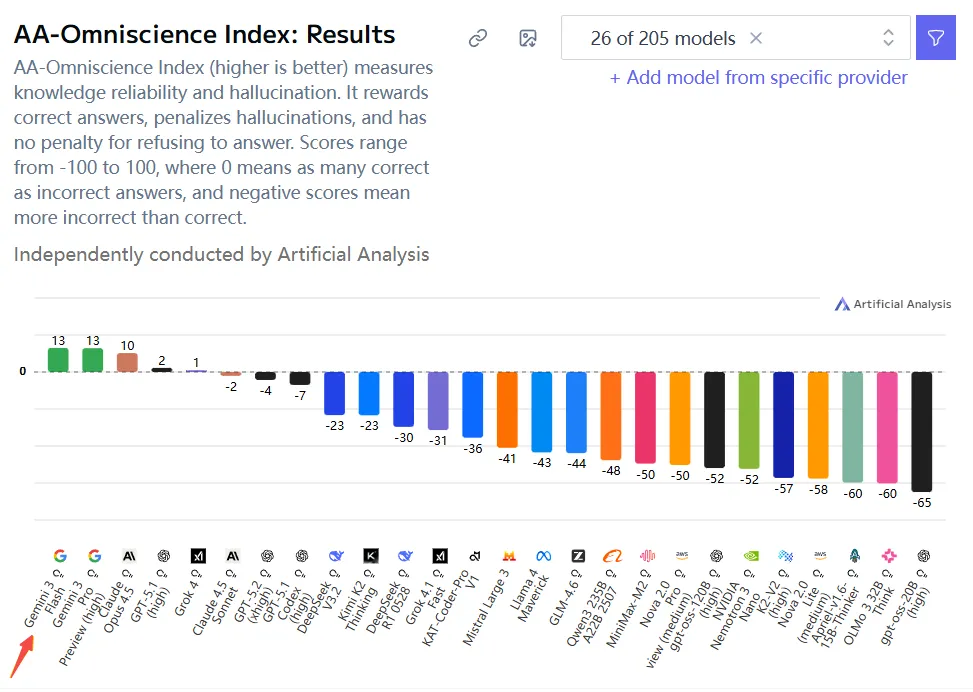
Among them, AA-Omniscience is one of the core benchmarks of the platform, specifically designed to detect whether AI models are "talking nonsense" (hallucinating) in high-value fields such as finance and law.
Testing Mechanism:
 )
)
In this demanding test, Gemini 3 Flash tied for first place with its own flagship Gemini 3 Pro with a high score of 13 points, winning both the accuracy and reliability index championships.
Why is this amazing?
In a harsh environment where the vast majority of models (including the Llama 4 and GPT-5 series) received negative scores due to wrong guesses, Gemini 3 Flash's performance is an anomaly. This data broke industry conventions, proving that:
Lightweight models can not only pursue speed but also reach or even surpass industry-leading levels in factual accuracy and hallucination suppression.
 )
)
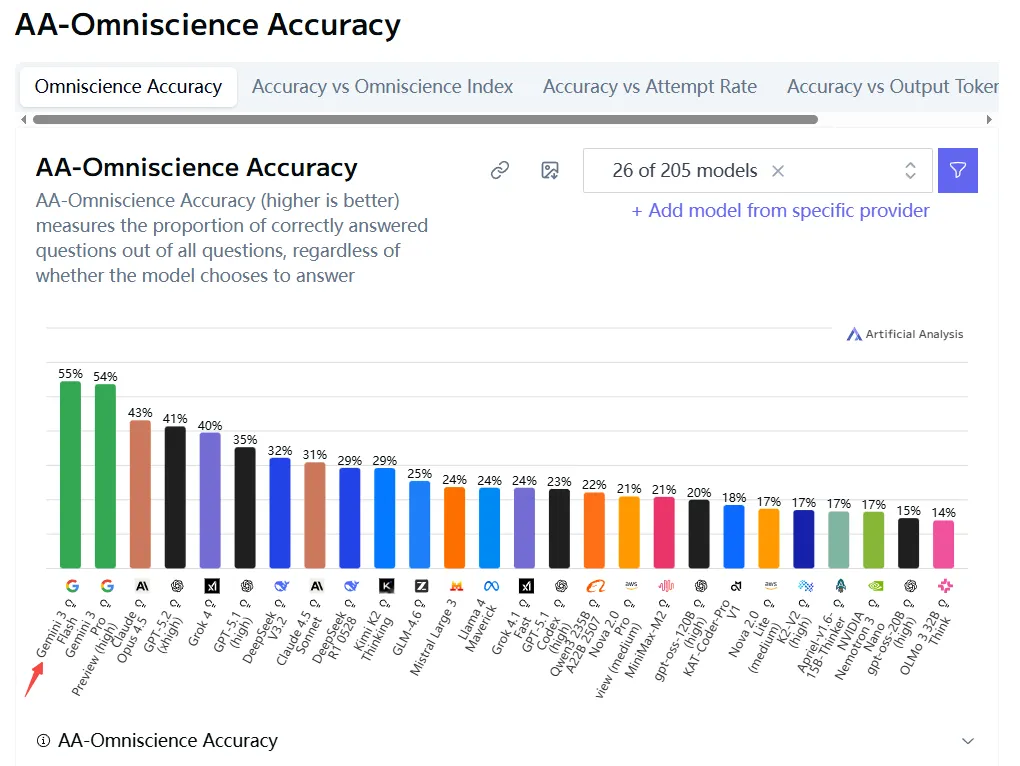
In terms of the absolute value of knowledge reserves, Gemini 3 Flash shows terrifying coverage:
What does this mean?
Facing massive general knowledge Q&A, Gemini 3 Flash possesses the most extensive knowledge base currently on the market. For scenarios requiring large-scale information retrieval and fact-checking, it beats all competitors with its "erudite" characteristics.
Applicable Scenario Examples:
 )
)
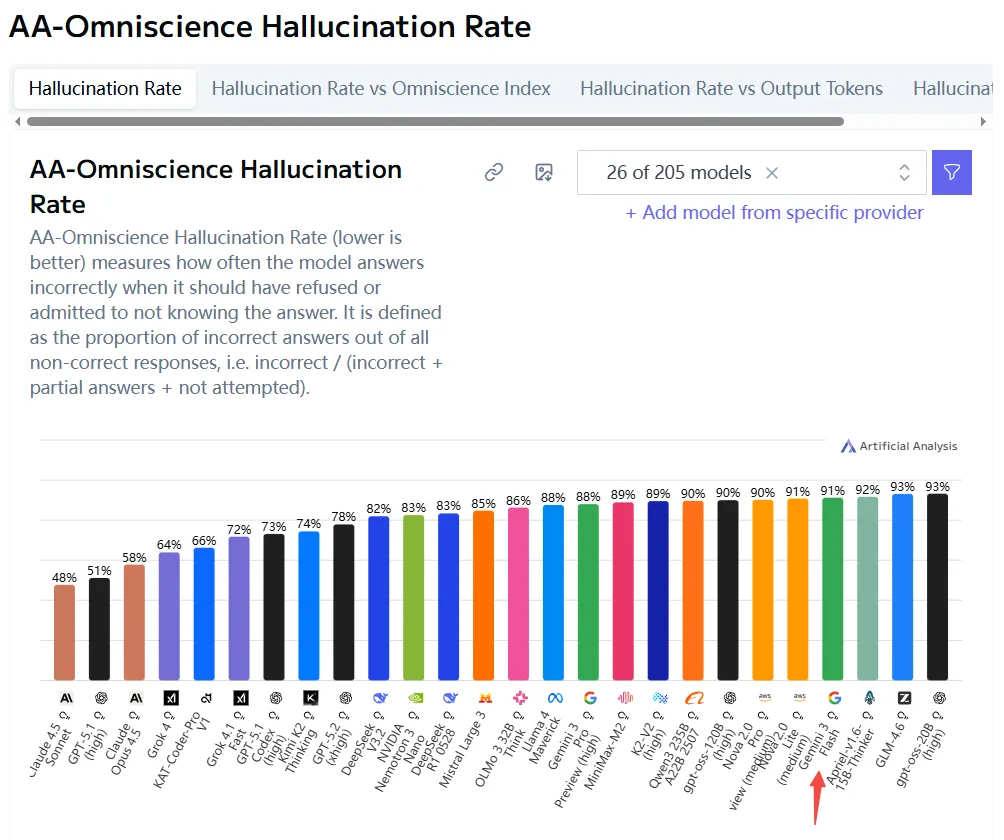
However, behind the glamorous accuracy lies a counter-intuitive statistic:
Gemini 3 Flash has a hallucination rate as high as 91%.
This does not contradict its high accuracy but reveals the model's extremely "confident" personality trait.
Simply put: Gemini 3 Flash has almost no "refusal mechanism".
When encountering knowledge blind spots, it tends to answer forcefully with a straight face rather than admitting it doesn't know. Although it knows a lot (high accuracy), once it touches a blind spot, it is extremely prone to generating misleading information.
Yes, it is very dangerous in certain scenarios.
When using this model in high-risk fields (such as medical diagnosis, legal consultation, financial investment), manual verification is an indispensable line of defense. The model's "overconfidence" trait may lead users to mistakenly believe incorrect information, causing actual losses.
 )
)
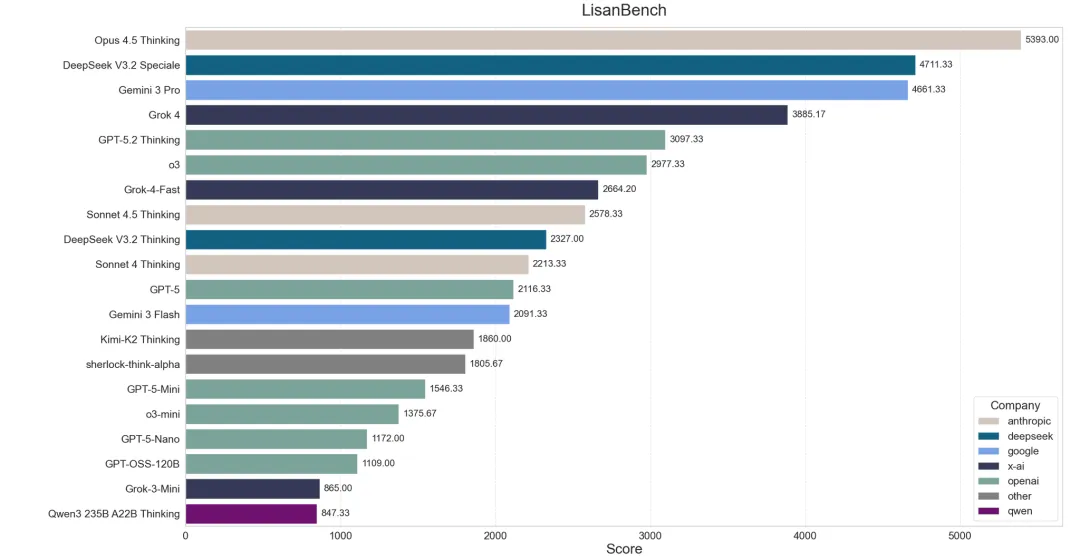
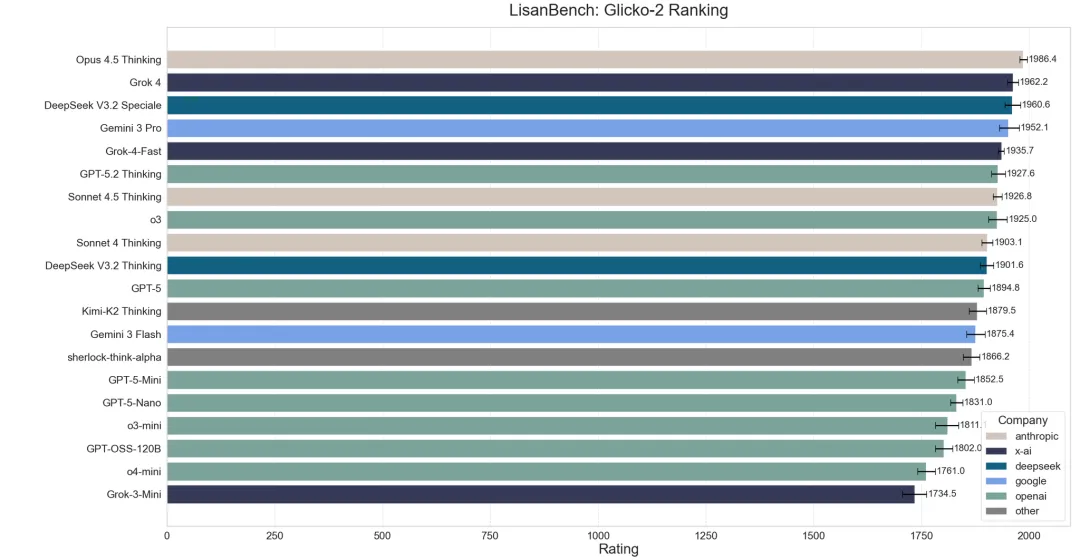
Leaving pure fact retrieval and entering the LisanBench test which examines deep logic, Gemini 3 Flash returns to its true positioning as a lightweight model:
This shows that in the face of extremely complex logical problems, it cannot replace "thinking" models.
Even so, it is still the absolute dominator in its ecological niche:
This proves that Gemini 3 Flash is currently the highest cost-performance "tactical" AI:
 )
)
In the Glicko-2 rating, which better reflects real-world combat capability, Gemini 3 Flash successfully held the midfield with a high score of 1875.4:
This again confirms Gemini 3 Flash's extremely high efficiency ratio (Performance/Cost):
It provides real-world performance almost close to the previous generation of flagship large models with lightweight resource consumption.
For enterprises balancing cost and performance, this is an excellent choice.
 )
)
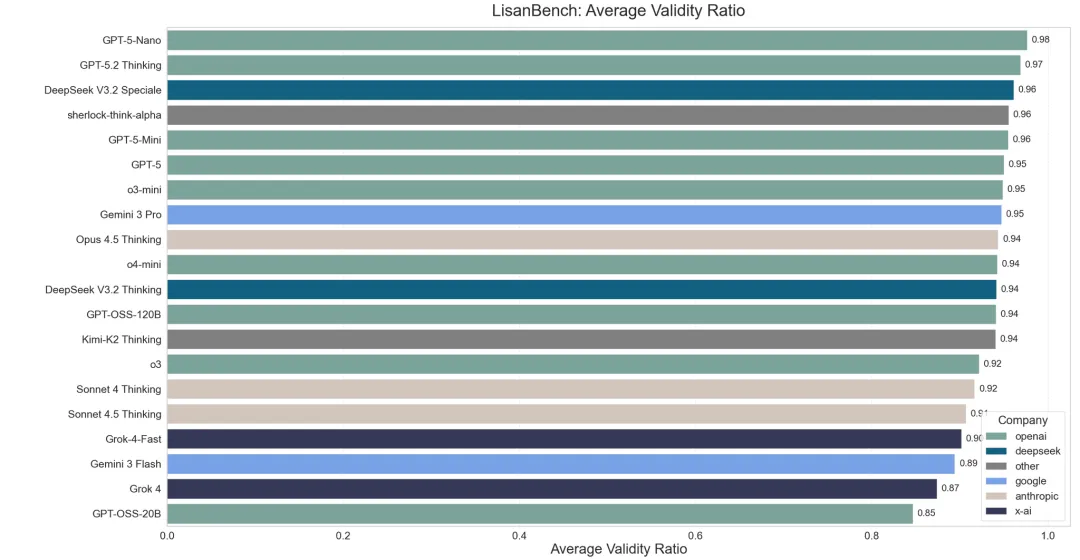
In the output format compliance (Validity) test, Gemini 3 Flash exposed its shortcomings:
This makes it look like a knowledgeable but sloppy old professor:
In contrast, although GPT-5-Nano is poor in knowledge, it is meticulous (0.98) in format execution.
This means:
 )
)
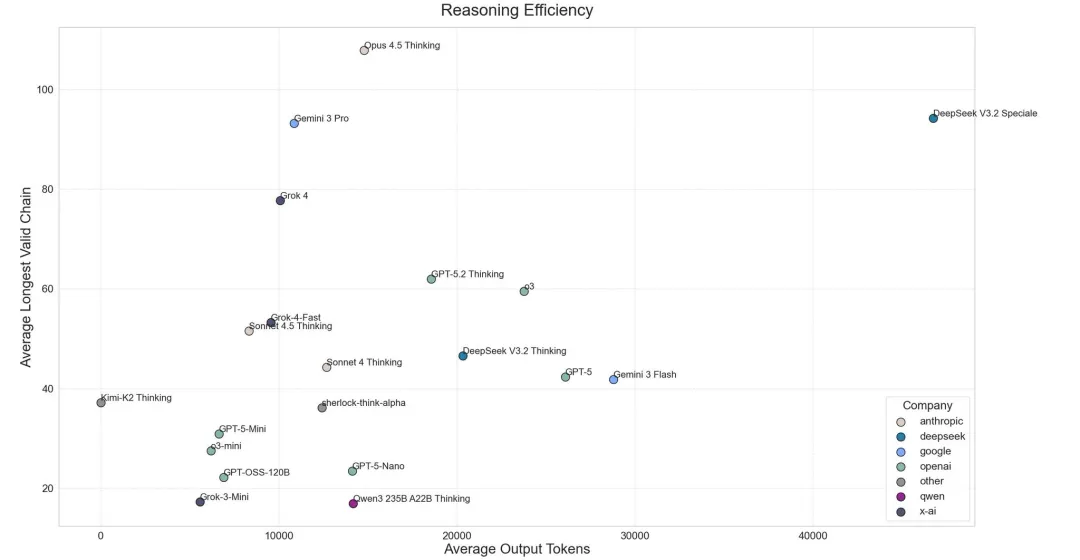
Combined with the Reasoning Efficiency chart, we discovered Gemini 3 Flash's unique working mode:
High consumption, medium output
This indicates that Gemini 3 Flash tends to generate massive amounts of text to cover problem details, that is, "exchanging quantity for quality", rather than hitting the core through precise logical chains like Claude Opus or Gemini 3 Pro.
Advantages:
Disadvantages:
Overall, Gemini 3 Flash is the most typical "biased genius" in the current AI market:
Advantages:
Disadvantages:
Recommended Use:
Use with Caution or Avoid:
The emergence of Gemini 3 Flash marks that AI models are moving towards an era of diversification and specialization.
It is not omnipotent, but it has achieved the ultimate in its professional field—massive knowledge retrieval and long text generation. The inspiration this gives us is:
When choosing an AI model, one should not blindly pursue "strongest" or "biggest", but should choose the most suitable tool according to specific needs.
The success of the Flash model also proves that lightweight models are not just "shrunk versions" of flagships, but can be expert-level tools optimized for specific scenarios.
In the future, we may see more such "biased geniuses": they surpass flagship models in certain fields and compromise in others. And this is precisely the sign of AI technology maturing.
After all, specialization in art is the essence of intelligence.
References:
This article content is for learning and exchange only. If there are any improprieties, corrections and discussions are welcome.